Maintenance tips

Should you remove the battery from an electric bike?
Homme sur vélo électrique avec batterie puissante

This question is frequent among e-bike users. Multiple factors must be considered to ensure optimal use, in terms of safety and battery lifespan.

Key takeaways :

  • It is recommended to remove the battery for charging, especially if your bike is far from a power outlet, so it can be stored in a dry and temperature-stable environment.
  • Removing the battery helps prevent theft, particularly if the bike remains outside or in a public area for long periods.
  • Remove the battery during very cold or hot periods to avoid damage.
  • If the bike is not used for several weeks, removing the battery and keeping it partially charged (around 50%) helps preserve cell health and prevents deep discharge.

Removing the battery for charging

Most e-bike batteries are designed to be removable, and it is recommended to take them out for charging—especially when the bike cannot be brought near an electric socket. This is not only more practical but also safer. Charging the battery indoors in a dry, room-temperature environment helps preserve its performance and avoid risks related to humidity or cold.

Even if some batteries can be charged directly on the bike, most manufacturers—including Bosch—advise removing the battery to maximize its lifespan.

The Expert Opinion from Doctibike

Doris – Customer Service & Product Coordinator at Doctibike

“To properly charge your e-bike battery and optimize its performance, follow these simple yet essential tips:

  • Removing the battery before charging allows better heat dissipation, prevents overheating caused by the limited space inside the frame, and extends the lifespan of the lithium-ion cells.

  • Charge the battery in a temperate environment, ideally between 10 and 20°C, in a well-ventilated room, on a stable and non-flammable surface. Stay nearby during charging to monitor any potential issues.

  • Regularly inspect the battery when it is removed: check the casing, contacts, and the cleanliness of the connectors. Clean them if necessary to avoid oxidation and poor contact, which can damage the battery.”

Preventing theft

The battery is one of the most expensive and vulnerable parts of an electric bike. For very short stops, the integrated lock may be enough. However, when the bike is left unattended for longer periods, it is strongly advised to remove the battery. A small bag or protective case allows you to transport it safely. This simple habit avoids many issues.

Batterie Bosch Powerpack 500Wh

Long-term outdoor storage

Lithium-ion e-bike batteries generally withstand normal weather conditions, such as light rain or temporary humidity. If your bike gets wet occasionally, it should not damage the battery, which is protected by durable housings and sealed circuitry.

However, if your bike stays outdoors for an extended period and is exposed to significant temperature variations, it is strongly recommended to remove the battery. Extreme temperatures—very low in winter or very high in summer—can affect cell performance and lifespan.

By removing the battery, you can store it indoors in a dry place with stable temperature (ideally between 10°C and 25°C), which prolongs its life and ensures proper functioning. Avoid leaving the battery in a frame exposed to dust, humidity, or metallic deposits, as this can cause corrosion on the connectors integrated into the bike and make maintenance more difficult.

Should you remove the battery if the bike is not used for a long time?

If your e-bike is not used for several weeks or months, it is recommended to remove the battery to avoid complete discharge. The battery naturally loses some charge even when not in use—this is called self-discharge.

Leaving the battery on the bike can lead to deep discharge, which quickly damages its capacity and reduces its lifespan. Removing it and partially charging it (around 50%) before storage helps protect the cells. To preserve your battery’s lifespan, we recommend charging it at least once a month to keep its charge level between 20% and 80%.

Special case: bikes with integrated batteries

On some bike models, the battery is protected by a cover or panel that can make removal more complicated. This system may be chosen for aesthetic reasons or to improve theft and weather protection.

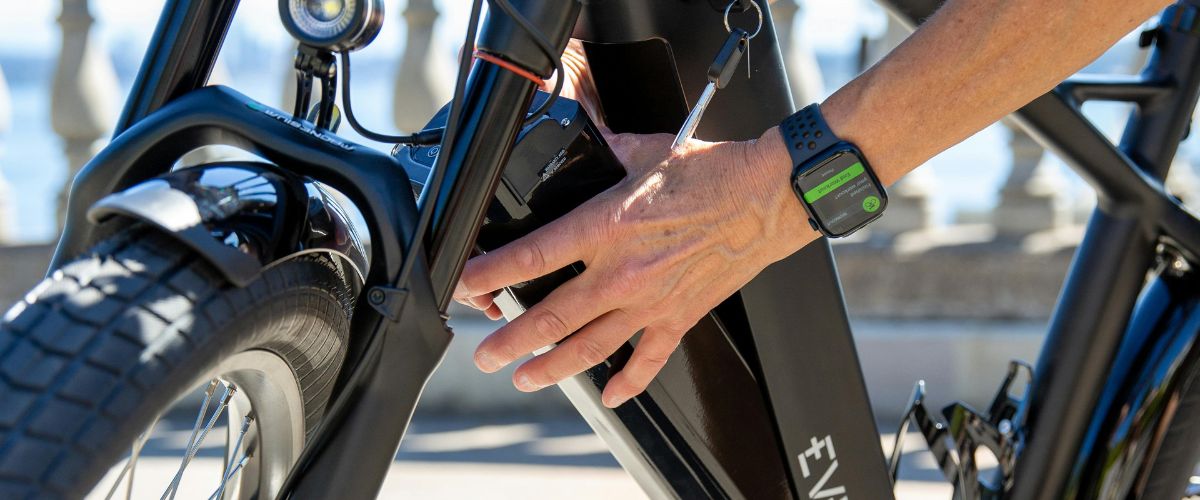
To remove the battery, you must first remove the cover, which may be clipped or screwed on. Sometimes this requires a tool (screwdriver or special key). On bikes with fully integrated frame batteries (such as certain tubular or Bosch PowerTube models), the process is more technical and may require removing the saddle or parts of the frame.

This extra locking system protects the battery but also makes removal more difficult—especially for frequent operations. In such cases, it is better to follow the manufacturer’s instructions or seek help from a specialist to avoid damaging the battery or cover.

Even though some batteries can theoretically remain on the bike during charging or short stops, it is strongly recommended to remove the battery in most situations. This simple habit improves safety, extends battery lifespan, and ensures optimal performance of your electric bike. To learn more, see our guide on how to properly remove your bike’s battery.